How Wooden Toys for Baby Grip Build Strength Safely
8/29/2026
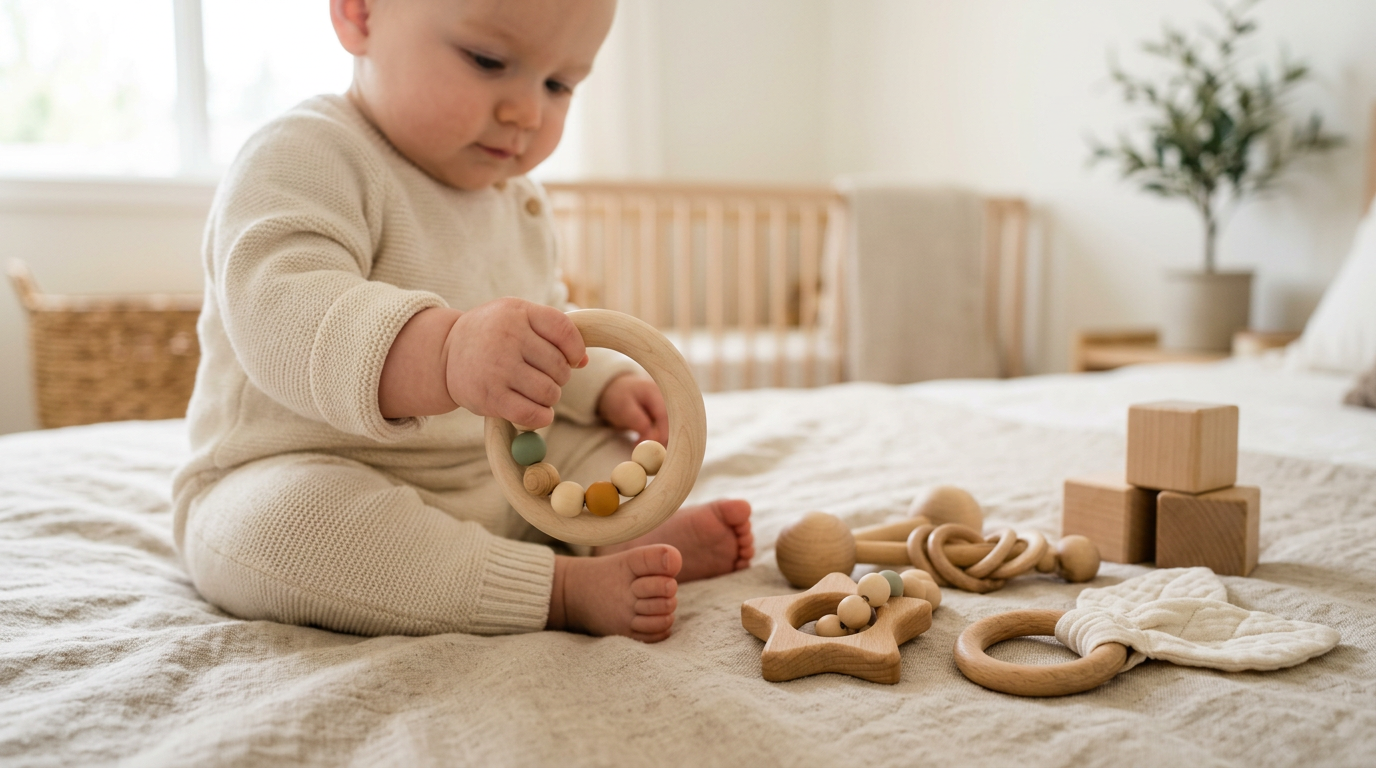
How Wooden Toys for Baby Grip Build Strength Safely
Wooden toys for baby grip give infants a stable surface to hold and manipulate. This supports early motor development without the risks of small parts or chemical finishes. Parents often notice improved finger control after consistent use of properly sized rattles and blocks.
Little Baby Toys designs pieces that match typical hand sizes at three to six months. The result is steady progress toward grasping and releasing objects.
Key Takeaways
- Wooden toys provide consistent texture that encourages repeated grip attempts.
- Rounded edges and natural finishes reduce irritation during extended play.
- Daily short sessions build strength more effectively than longer unstructured time.
- Size and weight must match the child's current hand span.
Parents report that babies who use one well-fitted wooden rattle daily show steadier improvement in grasp duration compared with those given varied plastic items. The uniform density of wood also reduces the chance of the toy slipping during early attempts.
Selecting Safe Wooden Rattles
Choose rattles with diameters between 1.5 and 2 inches. This range fits an infant's palm without requiring full finger wrap.
- Check for smooth sanded surfaces on every edge.
- Verify water-based finishes free of lead and phthalates.
- Confirm single-piece construction or securely locked joints.
- Measure weight between 2 and 4 ounces for early months.
- Avoid any rattle with detachable rings or beads.
Additional checks include testing the rattle for balance so it does not tip unexpectedly when placed on a flat surface. Families who keep a simple log of which rattles hold attention longest often identify the best fit within the first week of trials.
Daily Play Routines That Strengthen Grip
Short, repeated sessions produce better results than one long period. Place the toy within reach during tummy time.
- Offer the rattle at eye level and let the baby reach.
- Support the wrist lightly if the grasp slips.
- Rotate the toy so different surfaces face the palm each time.
- End the session after five minutes or when interest fades.
- Repeat the sequence two to three times daily.
Extend each session by one minute only after the baby maintains a firm hold for the full five minutes on three consecutive days. Record the exact time of day that yields the longest attention span to refine future routines.
Comparing Toy Materials for Grip Development
| Material | Grip Texture | Weight Consistency | Cleaning Method | Typical Lifespan |
|---|---|---|---|---|
| Natural wood | Moderate friction | Stable | Wipe with damp cloth | 5+ years |
| Plastic | Smooth or glossy | Varies by model | Dishwasher safe | 2-3 years |
| Fabric | Soft give | Light | Machine wash | 1-2 years |
Wood maintains uniform weight and surface feel across sessions. This consistency helps babies calibrate pressure. In contrast, plastic surfaces can become slick after repeated handling, while fabric toys compress too easily and offer little resistance for strengthening exercises.
Monitoring Progress in Infant Motor Skills
Track grasp duration weekly. At three months most infants hold an object for 10-15 seconds. By six months that time often doubles.
- Note whether the baby transfers the toy between hands.
- Observe if fingers curl fully around the shape.
- Watch for deliberate release into a container.
- Record any preference for one hand over the other.
Compare weekly notes against simple benchmarks such as the ability to hold the toy while rolling from back to side. If progress stalls for more than ten days, consider adjusting toy diameter or adding a slightly heavier option under close supervision.
Non Toxic Baby Toys Standards to Verify
Look for third-party testing labels. ASTM F963 and EN71 remain the common benchmarks in North America and Europe.
- Request material safety data sheets from the maker.
- Confirm no added colorants beyond food-grade pigments.
- Ensure the wood source is listed as sustainably harvested.
- Reject any item with visible knots larger than a pencil eraser.
Batch testing records should cover the specific production run rather than generic factory statements. Parents who request these documents directly from smaller makers often receive prompt responses that include photos of test certificates.
Integrating Developmental Play for Newborns
Newborns benefit from visual tracking before active grasping. Hang a wooden mobile 12 inches above the crib.
- Use contrasting wood tones to hold attention.
- Change the mobile angle every few days.
- Remove the mobile once the baby reaches for it consistently.
- Replace with a floor-based rattle once head control improves.
Transition timing matters. Moving to a floor rattle too early can frustrate infants who still lack head stability, while delaying the change may reduce opportunities for reaching practice.
Addressing Individual Differences in Grip Development
Every infant follows a slightly different timeline. Some babies favor one hand early while others show balanced use from the start.
- Observe whether the baby favors the left or right hand during the first month of play.
- Note any signs of frustration such as dropping the toy repeatedly within seconds.
- Adjust session length if the infant shows fatigue after three minutes.
- Introduce a second texture only after the first toy is held reliably for twenty seconds.
- Reassess size every four weeks as hand span increases.
Edge cases include infants born prematurely who may need an extra half-inch in diameter for the first eight weeks. In these situations, begin with the lightest wooden option and increase weight gradually. Families that document these adjustments see clearer patterns emerge over a six-week period.
Common Errors and How to Avoid Them
Many parents select toys that are either too large or too light. Oversized pieces frustrate early attempts. Lightweight pieces fail to provide enough resistance.
- Do not introduce multiple toys in one session.
- Avoid painted toys unless the finish is explicitly certified.
- Skip any item that shows splintering after one week of use.
Another frequent misstep is continuing with the same rattle after the baby masters it. Replace or rotate items once grasp time exceeds thirty seconds on average to maintain challenge without overwhelming the child.
Conclusion
Start with one or two wooden toys sized for three-month hands. Observe grip changes over four weeks and adjust size or texture as needed. Visit the CDC child development resources for milestone checklists. Review the American Academy of Pediatrics guidance on safe play materials. Consult the ASTM toy safety standards before purchasing additional pieces.
Next steps:
- Measure your child's current hand span this week.
- Order one rattle that meets the 1.5-2 inch diameter guideline.
- Schedule two daily five-minute sessions for the next seven days.
- Note grip duration on day one and day seven.
- Replace the toy when grasp time exceeds 30 seconds consistently.
FAQ
What age range benefits most from wooden toys for baby grip?
Infants between three and nine months show the clearest gains in grasp duration and strength.
How often should the toys be cleaned?
Wipe with a damp cloth after each use and allow to air dry. Deep clean monthly with mild soap and water.
Can these toys be used during teething?
Smooth wooden surfaces work well, but supervise closely and remove the toy if chewing becomes aggressive.
Are there weight recommendations by month?
Three to four ounces suits three-month-olds. Five to six ounces works better after six months.
Where can parents find verified non toxic options?
Look for makers that publish batch test results and use only water-based finishes on hardwoods.